by Heather Plett | Sep 2, 2005 | Uncategorized
Last night was one of those great evenings that make me so sad to see Summer pass. A free outdoor concert in Assiniboine Park, listening to Joel Kroeker (awesome) and The Wailin’ Jennys (even MORE awesome), hanging out with family and friends, racing Maddie across the lawn, eating donuts on the way home with Nikki and Maddie – all very, very good. It was a drizzly, windy, cool, lousy day yesterday, so we weren’t sure how the evening would go, but just before 7:30, when the concert was about to start, the sky cleared, the wind died, and it turned out to be a beautiful evening. It was still a little cool, but we hunkered down with blankets, and stayed pleasantly warm.
by Heather Plett | Sep 1, 2005 | Uncategorized
Yay! I got published again! I tell ya, no matter how many times I see my name in print, next to something I’ve written, I still get all giddy when it happens.
The Winnipeg Free Press published a piece I sent them a few months ago. And what’s REALLY cool is that one of my closest friends, Michele, also got a piece published this week. (She’s not bragging about it on her blog like I am, but believe me, she SHOULD. It was a great piece!)
I think I posted mine here a while back, but I can’t find it, so in case you want to read it, here it is…
___________________
Life is good — downsized, but way bigger
‘MY mom doesn’t like going to the mall,” I heard my daughter tell her friend recently.
She’s right. I HATE going to the mall. It reminds me of all the things I don’t have and don’t need but find myself wanting anyway.
I’ve been looking for a better balance in my life — between the things I want and need, and between the things that really matter in life and the clutter that gets in the way. A few years ago, my husband and I took a step back, re-evaluated what was important in our lives, and decided to make some changes.
In a culture where great importance is placed on acquiring more things, we found ourselves getting caught on the same hamster wheel as everyone else.
“Make more money to buy more things” the ads scream at you. Buy more things and then you need more money to maintain that lifestyle. Make even MORE money and start letting your things control your lifestyle. Get a bigger house, send the kids off to day care, buy a bigger van to pull the boat and the camper you just bought, get a better job, work more overtime, spend less time with the kids… you get the picture.
At some point in the vicious cycle on that hamster wheel, you either decide to commit yourself entirely to its endless motion, or you get off. A lot of people decide to keep spinning. We decided to get off.
The first thing to go was my husband’s job. He’d been miserable for quite awhile and found he had no desire to stay where he was, even if it provided a decent income. He longed for the education he’d never gotten. We weren’t sure we could survive on one income and somehow be able to afford his tuition, but we decided to take a risk.
If he arranged his classes around the kids’ schedules, we wouldn’t need a babysitter very often and our day-care bills would go down. The added bonus would be that our kids could spend a large majority of their time with their parents.
It wasn’t easy at first. We had to give up some of the luxuries of our lifestyle — fewer meals at restaurants, one less vehicle, no cellphone, more second-hand clothes, fewer vacations, no more cable TV, no more cleaning lady. But before long, we recognized the benefits were outweighing the costs.
We were spending more quality time as a family because we weren’t rushing around as much. We ate more wholesome food because we had more time to prepare meals rather than grabbing something quick after a long day at work.
The next step was my job. That was another big decision. I was offered a great job at a non-profit organization, but we just weren’t sure I could take the pay cut it required, plus lose all the benefits of a fairly long career in the government. Once again, though, we decided the risk was worth the pain.
We found more things to cut, and I took the leap. Again, the benefits far outweighed the costs. I was much happier, felt fulfilled in my new job, got great opportunities, and my whole family benefited when I came home at the end of the day with less stress and no “on-call” cellphone attached to my hip like an albatross.
These days, we’re facing more steps in our downsizing process. With the current cost of gas, and the consciousness that we are not doing the environment any favours by driving a big vehicle, we’ve decided to sell the van. We’re shopping for a car. Again, there will be costs.
We’ll have less space to haul around our stuff, the kids will probably fight more because they’ll be stuck sitting next to each other in the back seat And along with the van, we’ll also have to get rid of the “toys” we pull behind it. The big camper will give way to a small pop-up camper or tent. The boat will go.
A lot of people have told us we’re nuts. “You’re going back to school? But you’re almost 40!” “You’re quitting a good government job? Are you CRAZY?” “How in the world do you plan to live on only one income?” The kids have felt the pinch, too. Their friends get to have more cool toys, go on more exotic trips, live in bigger houses, have new clothes instead of hand-me-downs, get involved in more activities — it’s not easy to sit back and watch other people have all the fun, especially when you’re a kid.
Despite all of that, I don’t regret any of our decisions. In fact, now that we’ve taken a few major steps along the way, and I’ve seen the rewards, I actually look FORWARD to getting rid of the van, the camper, and the boat. I feel lighter already — like I’ve just thrust off a layer of winter clothes and can dance barefoot in the grass again.
There’s no way to define the value of all the things we’ve gained.
I didn’t realize the stress of our old lifestyle until it was gone. I notice it most when I come home from work. I come home happy because the stress of my old job is gone. My husband is happy because he LOVES school and feels fulfilled like he never has before. The kids are happy because they’ve been home with their dad and haven’t spent the last few hours at day care. Supper’s usually cooked because my husband likes cooking and has more time for it now. It’s all good.
I once met a woman in Africa living in a mud hut, and I wondered how she could be so happy. Now I’m beginning to understand.
No, we can’t go to Australia for our vacation this year. And no, we won’t be buying a bigger house, even though our little kitchen drives us all crazy. And no, we won’t be able to go out for supper this week, because it’s not in the budget. And yes, there are times when we’re not sure the paycheque will stretch to the end of the week.
I have to tell you, though, life is good.
Heather Plett-Laurendeau is a downsizing Winnipegger in an inexorably upscale world.
by Heather Plett | Aug 31, 2005 | Uncategorized
(Warning: One of my long “trying to be profound” posts ahead.)
I like to think I have a good command of the English language. I’m a communicator who spends a lot of time searching for the best way to communicate ideas, information, instructions, etc. I know a lot of words. And yet, there is so much I don’t understand.
Within the English language (and I suppose within any language), there are a lot of sub-languages – languages that are familiar and comfortable to those who speak them but are entirely foreign to everyone else. On the way home from work yesterday, I saw a woman with an interesting hair-do – short spiky dreadlocks – and I wondered if there was a word for that. It occurred to me that she probably had the language to define her hair-do. Or if she didn’t, at least her hairdresser did. I, with my mostly-straight blonde Caucasian hair, don’t have a reason to communicate in that language.
But there are also a lot of languages that I understand that neither that woman nor her hairdresser would. I’ve had to use a lot of different languages in my work life. Here’s a little sampling of statements that mean something to me, but probably sound like Yiddish to you:
Veterans Affairs: “Did you PA that BPA document to the VAC file? The AC wants the file to send it to the VAB. ”
Agriculture: “Next week, representatives from the CD will be meeting with someone from KAP and NFU. Could you prepare the doc for the discussion on HEMS?”
Health: “What happens with the NHP remains after they have been used for the SARS experiment? Will they be autoclaved out of the BSL4?”
See what I mean? Foreign languages. Everyone speaks them – either at work or at home. Your family probably has some words or phrases that mean absolutely nothing to anyone outside the family. My family, for example, is famous for using lines from an old comedy tape we used to listen to regularly. For those family members reading, remember “You COOKED it? But that bird spoke seven languages!”?
For much of my professional life, I’ve served as a translator, of sorts. It’s my job to distill the language of the experts (whether they’re scientists, agriculturalists, or international aid experts) into a language that you, Joe Average Public, can understand. . It’s not that I have to fully understand any of the languages I’m translating (it would take a PhD to understand most of what the scientists were saying), but I have to somehow convince the experts to dumb down the information enough so that I can understand it and communicate it to the public. Sometimes I get it right, sometimes I don’t. Any time you receive a government document, there’s a good chance that someone like me had their hand in translating it. (Hey – don’t blame ME for all the bad government communication out there! I could only do so much.)
When you receive some form of communication – be it a letter, a flyer, or a news piece on the television – you will very quickly shut it out if it has not been translated well. If the communicator speaks a language that’s foreign to you, they haven’t got a chance of catching or keeping your attention. That’s why advertisers are paid well – they have to figure out the language that is best understood and convinces you to buy the product.
We’re all trying to understand each other. Sometimes we get the translation right, sometimes we don’t. Sometimes the words are simple, but the message is complex. A simple statement like “I like your shoes” can mean so many different things. Do you REALLY like them or are you being sarcastic and you’ll snicker when I turn my back? Are you trying to imply that I spend too much money on shoes?
Language can be complicated. On the other hand, some forms of communication are beautiful in their simplicity. A smile, for example, translates into any language. I “spoke” to many people in Africa, even though I didn’t know their languages. Watch a child for awhile – they find simple and effective ways to communicate. Yesterday, in a store parking lot, Maddie stopped to admire and talk to a Chinese baby in a stroller. The parents spoke very little English, but they understood that this small child wanted to be friends with their baby. They grinned and patted her head.
Next month, I’ll be facilitating a workshop where I’ll be working as yet another form of translator. It’s a teambuilding workshop, and I’ll be teaching the concept of Six Thinking Hats to help the group understand that people have different ways of thinking and different personalities, and therefore tend to communicate with different languages. When someone says “I don’t like that idea” it may very well mean “that scares me because it’s outside of my comfort zone” or “I feel badly because I have nothing to contribute and you’re always coming up with the good ideas” or “perhaps we can build on your idea to come up with something even better.”
The other night at bedtime, the girls and I read the Bible story of the Tower of Babel – how the people were getting too proud and greedy and self-important, so God confused their language so that they could no longer communicate. Seems that story can be interpreted in many different ways. Maybe they all kept speaking the same basic language (Hebrew, I suppose?), but God changed everyone’s Myers Briggs personality type so that they all interpreted what was being said through different lenses. And consequently, we now have to have workshops and teambuilding sessions to try to bring people back together so that they can build their own mini towers of Babel. Who knows.
Though the languages we speak can make life complicated, and the way we interpret those languages can lead to way too many misunderstandings, I think it’s also what makes life interesting. If, for example, your workplace or home didn’t develop its own language, than nothing would set you apart and you wouldn’t have a special place to feel at home. If my family didn’t repeat silly lines from a comedy tape ad nauseum (to those who married in to our family, I sincerely apologize for the times you’ve had to try to interpret) then we would have fewer strings bonding us together.
Language is one of the building blocks of community. When we share a language, we share ideas and emotions, and we find ways to cling together. Even the blogosphere can do that – how about lol or rofl or btw? Those outside our community wouldn’t understand. (And if you’re inside the community, and don’t understand, I really don’t mean to leave you out, so what I just said was “laugh out loud”, “rolling on the floor laughing”, and “by the way”.) We may come from different places, but if we can share a common language, we can communicate and bond, at least on some levels. We might not always understand the nuances of what other people are saying, but we try, and on that effort, we build relationships.
(Don’t say I didn’t warn you!)
by Heather Plett | Aug 31, 2005 | Uncategorized
It’s hard to imagine how all those people in Louisiana and Mississippi are going to pick up the pieces of such a broken life. One woman said “All I found that belonged to me was a shoe. There’s nothing left.” How do you begin to rebuild a life with nothing but a shoe? Of course there are those in even worse situations – losing wives, husbands, children, and parents. Where will they begin?
If everything and everyone I knew was swept away in some angry storm, I don’t know if I could hope to do more than crawl into a hole and die.
And again, one wonders – is there REALLY a gracious god in charge of all this? My guess is, that if there is, then he/she is weeping right now. Weeping and longing for something different.
by Heather Plett | Aug 30, 2005 | Uncategorized
Lest you should think that all our downsizing (from 2 incomes to one, etc.) and selling off of earthly possessions (van, camper, boat) means that we’ve completely turned into “simple living altruistic tree-huggers”, I have to come clean and admit that we do still like to treat ourselves now and then. When we sold the camper, we paid off some bills and stashed some away, but then we allowed ourselves a little “fun money”. It’s been awhile since we’ve made any impulse buys, so this week we acted on impulse.
Marcel bought a bike (not as nice as mine, but still quite nice), I bought a digital camera (not quite an SLR but a step up from point-and-shoot. Yippee!), Nikki is now the proud owner of an MP3 player, and Julie’s on the search for a beanie bag chair. Maddie seems fairly content with the “gameboy” she got with her happy meal at MacDonalds – it has buttons to press and it beeps – what more does a three-year-old need? Hey, ya gotta love a three-year-old’s simple value system!
Here are a couple of shots with my new toy… 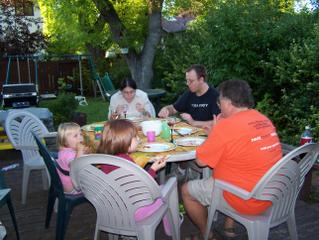
Supper in the backyard with our friends Justin and Nicole – yummy barbecued pizza!

Maddie perched in her favourite spot in the backyard tree.
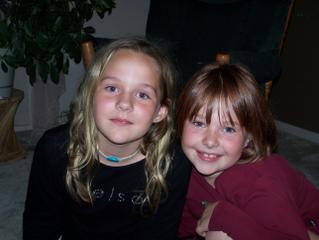
Nikki and Julie in a rare moment – close enough to touch, but NOT FIGHTING!
by Heather Plett | Aug 25, 2005 | Uncategorized
“Because we are flesh, we know best that with which we are familiar. We love most those around us. We yearn for connections to real people in real places, people we can touch and who can touch us. We love most intensely those people around us. We hold our children in our arms, and we breathe with them as one, and we love them deeply in each breath. And that is as it should be. We are flesh that touches and is touched.
But at the same time we are spirit. We know that to live our humanity to its fullest requires moving beyond the flesh.
And so we know there can be no difference between how we treat those we love and those on the other side of the world whom we will never know and never touch. If our lives and the lives of the ones we love have value – if by virtue of being human we have a claim to life and dignity in living – then everyone must have that same claim.
We know that the children we hold in our arms have exactly the same value as those children we will never see, held in the arms of those we will never know. If our lives in flesh are to make any sense, our spirit must move beyond the ones we touch, the ones we love.
This is our struggle, and it is hard, because when we lose a loved one, when someone we have touched and who has touched us suffers, we cannot help but feel it more deeply. Our flesh aches. That is what it is to be human.
And at the same time we have to push ourselves to think about the suffering of those we will never touch. Our spirit has to ache as deeply as our flesh. That, too, is what it is to be human.
If we are the people we say we are – if we believe the things we profess to believe, if we want to build the world we claim to want to build – then we must struggle with this. And it will be hard.”
Robert Jensen
You can read the rest of the article here