by Heather Plett | Jul 7, 2005 | Uncategorized
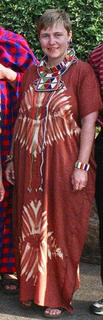 I’m wearing my African dress today. Here’s a picture of me wearing it in Africa. (I’m not as fully decked out today – I left the Maasai necklace at home.)
I love wearing it. It gives me those warm fuzzies… memories of the place I bought it. The Serengetti Stop-Over, a delightful place where we stayed in rondebels (round huts with thatched rooves), and sat sipping African wine (some was good, some was not) in the screened lounge watching the sun set over the Serengetti plains. Aahhh. Just indulge me for a moment and let me go back there in my mind…
It was a day of anticipation. The next day, we would cross the Serengetti. What we didn’t know yet was that the next day we would see hundreds if not thousands of amazing animals – elephants, hippos, wildebeest, zebras, giraffes, lions, warthogs, gazelles, and – did I mention zebras? Thousands of zebras.
But sitting there in the Serengetti Stop-Over, wearing my new dress, I didn’t know that yet. I only knew that it was a beautiful moment, that the air was warm and sweet, that I’d already fallen in love with Africa, and that I knew I still had much to anticipate in the coming week. Oh, and I knew that there was a delightful little gecko scampering up the screen door.
Lately, there’s been alot of talk about how the G8 can or cannot help Africa address poverty. Nobody has the magic bullet. All I know is that, if you ever have a chance to travel there, I guarantee that it will change your life. It is the most incredible place I’ve ever been. Yes, the poverty is hard to see, but the people are remarkably strong, full of spirit and wisdom and grace. And they could teach us volumes about living in community and helping our neighbours. I believe that they will perservere and someday, we’ll see Africa arise like a phoenix.
Note: If you want to see more of my pictures, you’re welcome to check them out at heatherplett.com (yes, I have good intentions of having an actual site there someday, but for now it’s just the pictures). Be prepared – there’s LOTS of them.
by Heather Plett | Jul 7, 2005 | Uncategorized
I’ve heard it said that the moment you give birth, you gradually begin to let go of your child. One of those steps in the process happened today. We dropped Nikki and Julie off at sleepover camp for the first time (along with their cousin and friend). For three whole nights, they will live independently of any of the grown-ups who are normally attached to them (yes, there are other grown-ups at camp, but not THEIR grown-ups).
It’s with mixed feelings that you let them go. You want them to become independent. You want them to try new things and not rely on you for their security all the time. You want them to begin to experience life on their own and to trust their own intuition and choices more and more. But at the same time, you’re not quite sure you’re ready for them to need you less. It’s exciting and scary all at the same time. Every time the phone rings, a tiny part of you wonders “is it them? are they calling to say they’re just too scared to be away?”
I know they’ll be fine. They’re smart and strong and independent. But I have to admit, this is a little tough, this letting go stuff. I miss them. I feel a bit of a lump in my throat.
Funny thing is, as long as I’ve had kids, I’ve had to travel for work, and, though I know it sounds a little callous, I hardly miss my kids when I’m away. I enjoy the chance to travel and I’m usually too busy to get lonesome. But now that THEY’RE the ones away and I’m at home, I miss them more than I’d expect.
Yeesh! If I’m this much of a sap already, how hard will it be to deal with an empty nest? I may need to come to some of you more seasoned parents for advice.
by Heather Plett | Jul 5, 2005 | Uncategorized
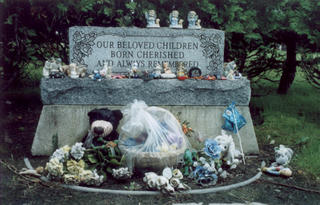
The caption engraved on the stone says “Our beloved children – born, cherished, and always remembered.” In front of the stone is a locked sarcophagus. Inside are buried the ashes of hundreds of tiny babies. One of those babies is my son Matthew. Born September 27, 2000. Died September 27, 2000. Like all the other little babies who share his grave, he was born still and breathless. The only life he knew was inside the warmth of my womb.
There’s a little menagerie surrounding the grave stone. The families who love those little buried babies leave mementos – things that help them stay connected to the children they lost. There are stuffed toys, plastic angels, flowers, candles, toy cars, Barbie dolls – even a hockey puck. Some items are more personal – obituaries, poems penned by those left behind, and photographs. Each was lovingly placed by some trembling hand. Many were baptized by tears.
Two of the toy cars were placed there by my daughters on their brother’s second birthday. In their own way, they want to remember him too. They wonder what he would have looked like at 2, at 3, or at 4 years old. Soon it will be his 5th birthday. Would he have climbed trees and played hockey? Would he have teased his big sisters?
I love to visit that little menagerie. I feel connected while I’m there – not just to my son, but to all the other families who had to say good-bye before they were ready. Each of those people knows what it feels like to hold a dead baby in their arms. Each of those mothers knows the pain of breasts overflowing with milk that will never feed a child.
Sometimes I go there to think or to write. Sometimes I just sit and cry.
The objects on that stone are sacred. Most of them are weathered and worn. Usually I leave them alone – afraid that they may fall apart if I touch them. Sometimes, though, I spot a new toy or a new bouquet of flowers and I wonder if there’s been another burial.
There are some things I can’t quite resist touching, though. I read the poems if they haven’t been obliterated by the rain. I look at the pictures. Once there was a small heart-shaped memory box. Inside was a letter and a plaster mold of a tiny foot. The tears flowed as I returned the box to its spot in the menagerie.
Each of us who visit that grave want remembrance. We want our children to mean something. By leaving earthly toys for our heavenly babies, we cling to the belief that they are real and that their little lives had value. When you’ve touched the tiny little fingers of a stillborn child, you know that your life will never be the same again.
If only we could hold them again. If only we could introduce them to our friends.
by Heather Plett | Jul 5, 2005 | Uncategorized
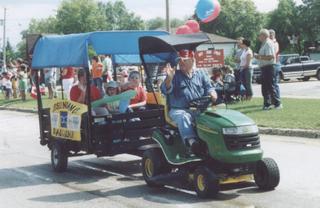
If you knew Marcel’s dad, you would know that, in his version of the world, IT JUST DOESN’T GET MUCH BETTER THAN THIS!!! This is the pinnacle, the epitome, the pièce de resistance (no, please don’t correct my French) – he got to combine so many of his favourite things – riding his John Deere, building a float, AND showing off his grandchildren ALL IN THE SAME DAY! He was a happy, happy man. And we were all very glad that the rain stopped before the parade began.
If you look closely, you’ll see that he even managed to add a little chrome to his tractor. Yeehaw!
If you want to see a little microcosm of small town prairie life, show up the day they have the parade – especially if they’re celebrating their hundredth anniversary. It just felt so nostalgic and so filled with humanity. Make sure you bring a plastic bag, though, to collect all the candy that gets tossed at you from the people on the floats.
by Heather Plett | Jul 2, 2005 | Uncategorized
Yesterday was white band day for the Make Poverty History campaign. Today, musicians all over the world are singing in honour of Live 8.
I’m wearing my white band, and I just watched Sting sing “Message in a Bottle” at the Live 8 concert in London. I think it’s a great campaign and I hope it makes a difference. I hope people get energized to make a difference to even out the power structures in this world and give developing countries a chance.
But there’s something that troubles me about all this. Earlier, I saw Bob Geldof introduce the young girl who’d survived the Ethiopian famine 20 years ago, and his statement was “Because WE did this – because WE had a concert 20 years ago, she is alive, healthy, and beautiful”. Well, bravo Bob for energizing the world this way. You’re inspirational and powerful and determined to make a difference and I admire that. But the trouble is – in some ways, these “you can make a difference” messages get converted into “they can’t survive without us” and “we’re powerful and rich and we need to lift them out of the gutter” mentality.
No, I’m no expert in international development. But I’ve been thinking about it alot lately, and I just wonder if somehow we could make sure that, in the middle of our charity and campaigns, we could keep sight of the dignity of the people we’re trying to help. They’re not just “poor Africans”. They’re beautiful, hardworking people, and they’re trying hard to improve their lives. Yes, we need to support them, but let’s make sure we honour them first. And let’s keep in mind that charity sometimes translates into power imbalances.
According to Michael Maren in The Road to Hell: The Ravaging Effects of Foreign Aid and International Charity, “The starving African exists as a point in space from which we measure our own wealth, success, and prosperity, a darkness against which we can view our own cultural triumphs. And he serves as a handy object of our charity. He is evidence that we are blessed, and we have an obligation to spread that blessing… Starvation clearly delineates us from them.”
In honour of Live 8, here’s a story about my experience in Africa…
Paulina’s Story
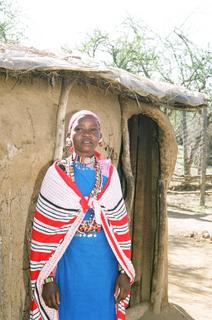
Her name is Paulina. She was wearing the traditional attire of Maasai women when I met her – layers of colourful fabric tied around her waist and shoulders, a beautiful (and no doubt heavy) variety of beaded necklaces around her neck, more beads wrapped around her drooping earlobe, a brightly coloured headscarf tied around her head… and a broad smile shining from her face.
She stood in front of her mud hut. At first, I approached her tentatively, not sure whether I had any right to impose on her. Her grin broadened as I neared, and she stepped forward eagerly, offering her hand. I started to ask whether I could see her house, but before I could speak, she’d gestured me inside. Others in my group followed.
She led us through the narrow hallway to her bedroom. Inside were 2 small beds where she and her husband slept. Between the beds was a primitive oil lantern on a small table. The only other thing in the room was a shelf over one of the beds where a couple of tin boxes held all of their personal belongings. She gestured for us to sit on the narrow beds made of rough sticks and ropes with thin mattresses covering the frames.
Next to her bedroom was another small bedroom (not a “bedroom” really, just a bed with a blanket hanging in front it). She leaned over the bed to open a flap in the wall to let the light through the small hole in the wall. This was where 2 of her children slept. The third child slept in another bed in the tiny kitchen. In the centre of the floor of the kitchen, not far from the bed, was a small fire pit. On the wall hung 2 or 3 cooking pots.
That was all there was to the house. The entire structure was smaller than my living room. She’d made it herself out of sticks she’d gathered in the forest, coated in cow dung left to dry to a concrete-like consistency in the heat of the sun.
What surprised me (and pleased me, though I didn’t recognize this until later) about this visit to a home so primitive I could not have imagined it before I traveled to Africa was that I didn’t feel pity for Paulina. The broad smile on her face, her eagerness to show us her home, even the way she leaned over her child’s bed to open the flap and let the light shine in – these things showed a woman who didn’t want my pity. She wanted my friendship. She wanted us to find a common sisterhood somewhere beneath the things that made us different. I wanted that too – longed for it.
Now, a few months after I returned from Africa, I can’t get Paulina off my mind. I miss her. I’d like to know her more. I’d like to share stories of motherhood and womanhood. I’d like to find the places where our feet stand on common ground. I’d like to welcome her into my home like she welcomed me into hers.
I don’t want to pity her. Nor do I want to paint a picture of someone who needs our pity. Yes, her life is full of challenges. They haven’t had enough rain to grow a decent crop in a number of years. She has to walk miles to get water. She doesn’t always have enough food to feed her children, or enough money to send them to school. All of these things are true, but pity won’t make her life better. Pity only serves to separate her further from me – it broadens the power gap and worsens the problems associated with global poverty.
Truth is, she could pity me too, for so many reasons. But I don’t want her pity either.
What Paulina and all of her African sisters and brothers (dare I say MY African sisters and brothers) need is not pity. What she needs is friendship. That’s what I need too – what all of my North American brothers and sisters need. If I am her friend, as I hope that I have the right to call myself after such a short visit, than I will remember her and long to find ways to bless her. If I am her friend, than I will allow her to bless me in return.
Pity is a one-way street. Friendship has well-worn paths in both directions. Pity builds power structures and walls. Friendship breaks down the walls and puts up couches and tables. Pity broadens the gap. Friendship builds a bridge.
What I long to do is find a way to build community with my new friends in Africa. I may not see them again. I may never get another chance to visit that beautiful continent. But even if I don’t, I want to serve them somehow. I want to honour their friendship. Within community, people serve each other toward a common good. In the short time we were together, Paulina blessed me greatly by welcoming me into her home and teaching me lessons in friendship, community, and simplicity. Now I want to take those lessons to heart and find a way to share them.
I am blessed with a wonderful community of friends. We share meals, we care for each other’s children, we wrestle with some of life’s tough questions together. Part of being a successful community means reaching beyond the boundaries of your community to welcome those around you – to offer them compassion and understanding. We’re getting pretty good at that. We serve soup and food hampers to those in the neighbourhood who can’t afford to eat. But we don’t just stand at the door and hand it to them – we welcome them in and we sit and eat with them. We honour their humanity. We acknowledge that they are of value to us just as we are of value to them.
This is what I want to share with my African friends. No, we probably won’t eat many meals together, given the vast ocean between us, but perhaps knowing them will impact my life enough that I will make decisions an
d try to live a lifestyle that doesn’t harm them further. If I can put my greed and consumerism aside and look for ways to level off the power imbalances, than I will have been true to our friendship. Perhaps, along the way, I can convince other people to do the same.
by Heather Plett | Jul 2, 2005 | Uncategorized
Despite the fact that there are FOUR girls in this house and only ONE guy, Maddie insists on arranging the toilet seats to suit her Daddy. She’s forever putting the toilet seats up and saying, in her best pleasing-daddy voice, “Daddy, I put the seat up for you!”
Those two spend too much time together!

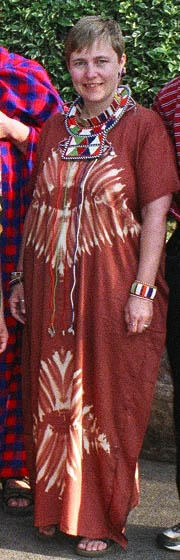 I’m wearing my African dress today. Here’s a picture of me wearing it in Africa. (I’m not as fully decked out today – I left the Maasai necklace at home.)